
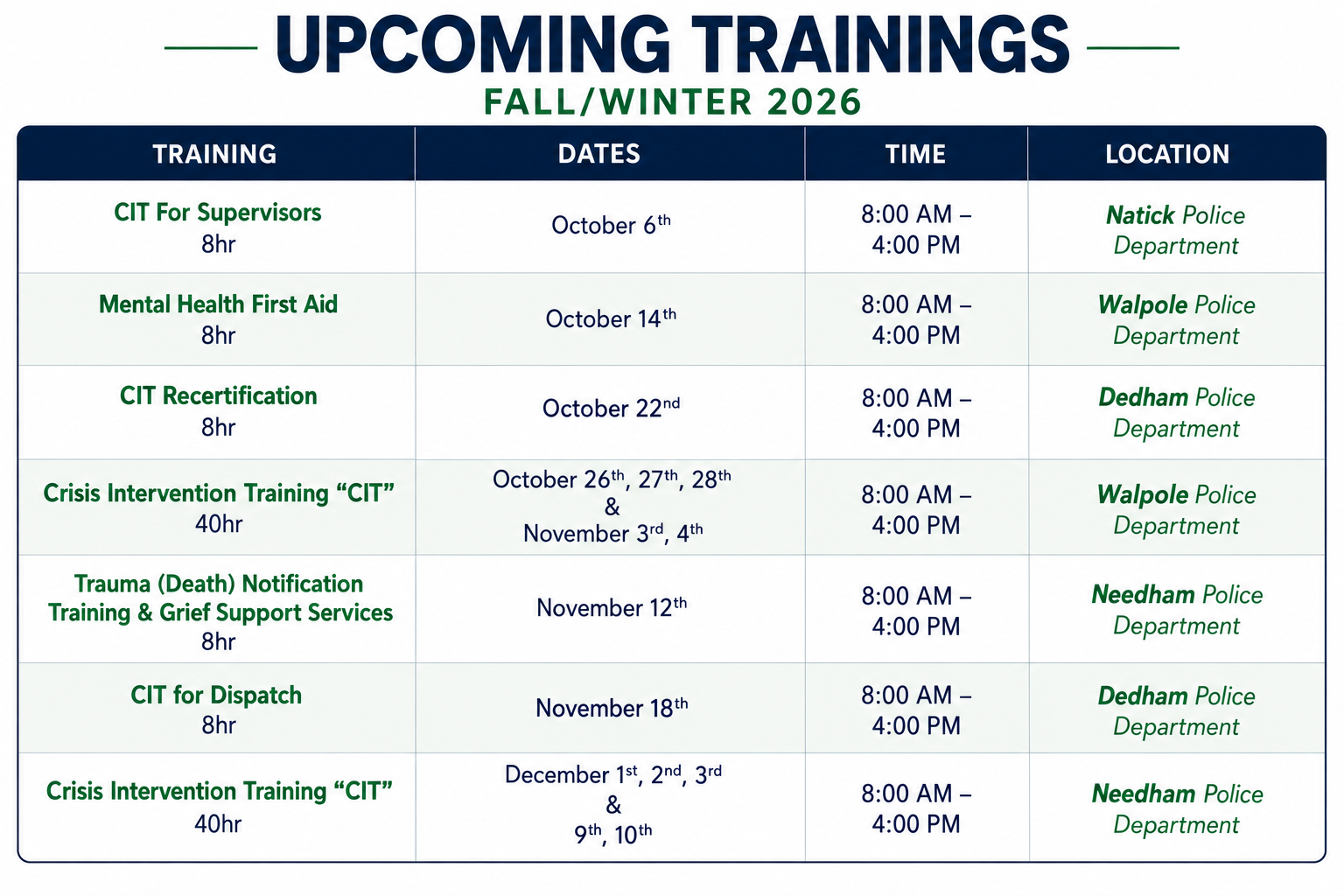
All trainings are funded through DMH, and free of charge for Public Safety personnel to attend. Please email us at: gmarpozan@brooklinema.gov or cmalinn@brooklinema.gov if interested in attending.
Types of Trainings
-
A 40 hour, 5-day comprehensive training designed to give police officers better recognition, communication and de-escalation techniques when dealing with persons with mental illness as well as other people from vulnerable populations. It provides a different perspective on mental health and enables officers to conduct better follow ups and referrals in these cases. The goal is to divert these individuals away from the Criminal Justice System and towards necessary treatment, when appropriate.
-
This one-day training is designed to enhance supervisory leadership during mental health related calls and critical incidents. It builds upon core CIT principles and emphasizes the supervisor’s role in overseeing and strengthening departmental behavioral health response programs, including CIT implementation. The training focuses on decision making, scene management, officer guidance, liability awareness, and supporting both community members and personnel during high stress encounters. The goal is to strengthen leadership practices that promote effective, compassionate responses while supporting officer wellness and accountability.
-
This 16 hour training focuses on servicing the needs of children in crisis (through high school age). It combines education, resources and de-escalation skill building. This training would be particularly useful for SROs or officers who frequently work with youth.
-
This is an 8-hour training course for public safety professionals that teaches them how to identify, understand, and respond to individuals experiencing a mental health or substance use crisis. The course uses a 5-step action plan to de-escalate incidents, connect people with appropriate care, and includes self-care strategies for officers and their colleagues. The goal is to provide a more appropriate response to mental health crises, prevent tragic outcomes, and improve community safety.
-
This training was developed by the FBI’s Victim Services Division with the goal of providing participants with information on a four-step, evidence-informed trauma notification model for providing sensitive notifications to family members or other impacted parties with professionalism, dignity and compassion. Representatives from LOSS teams (Local Outreach to Suicide Survivors) will join us to share resources and detail the work they do immediately following a suicide to support loved ones and survivors.
-
An 8-hour specialized training designed to help emergency communications personnel recognize and effectively respond to mental health crises and other situations involving vulnerable populations. The course emphasizes crisis communication, caller assessment, de-escalation strategies, and information gathering to support safe, coordinated responses.
-
This 8 hour training is an evidence informed, modular approach to assisting individuals to reduce distress after a potentially traumatic event such as natural disasters, terrorism, a public health emergency or a personal crisis. This training will assist officers in providing support to community members, fellow officers as well as to themselves immediately following a potentially traumatic event.
-
This training is recommended by DMH and the MPTC for officers who attended the five-day CIT training more than three years ago. It will consist of a review and updates on the most important portions of the CIT Training. The re-certification will ultimately be loaded into the attendees' training records in ACADIS.